

SimplifyC++ Article
Memory Allocation Mechanisms in C++
Memory Allocation Mechanisms in C++
In C++, memory allocation is a fundamental aspect of memory management. Developers must make conscious decisions about how to allocate and release memory to ensure efficient and safe program operation. This chapter covers both static and dynamic memory allocation, explaining the concept of pointers, their benefits, definitions, uses, handling, and types. We'll also highlight common memory issues like memory leaks, using memory after it's freed, uninitialized pointers, double freeing of memory, and memory overflows.
1. Static and Dynamic Memory Allocation
Static Memory Allocation
Static memory allocation occurs when memory is allocated to variables at compile time. Static variables are typically defined at the global level or with the static keyword. These variables remain in memory throughout the program's execution and cannot be resized or released during runtime.
Example:
static int number = 10; // Static allocationint globalVar = 20; // Static memory allocationAdvantages of Static Memory Allocation:
Access Speed: Accessing statically allocated variables is faster compared to dynamic memory, as their memory locations are known to the compiler in advance.
Simplified Management: The compiler automatically handles memory allocation and deallocation.
Disadvantages of Static Memory Allocation:
Fixed Size: The size of statically allocated variables cannot change after compilation, which may lead to memory wastage if the allocated size exceeds actual needs.
Limited Flexibility: It may be challenging to handle cases where data sizes change significantly during program execution.
When to Use Static Memory Allocation:
For constants like π or e.
When data size is known in advance.
For global variables accessible throughout the program.
When high data access speed is necessary, as memory locations are predetermined.
Dynamic Memory Allocation
Unlike static allocation, dynamic memory allocation occurs at runtime using the new operator. This memory is allocated from the heap, a flexible memory area that can be allocated and freed as needed. This allows developers to create data structures of unknown or variable size at compile time.
Example:
int* ptr = new int; // Dynamic memory allocation for a single objectint* arr = new int[10]; // Dynamic memory allocation for an arrayAdvantages of Dynamic Memory Allocation:
Flexibility: Memory size can change at runtime.
Efficiency: Only the necessary memory space is allocated.
Disadvantages of Dynamic Memory Allocation:
Relative Slowness: Allocating and freeing dynamic memory is slightly slower than static allocation.
Risk of Memory Leaks: Failure to free allocated memory leads to memory leaks and performance issues.
Complexity: Dynamic memory management requires careful handling by the programmer.
When to Use Dynamic Memory Allocation:
When data size is unknown, such as when it depends on user input or other runtime factors.
When data size needs to change at runtime.
For complex data structures like linked lists and trees, as their size can vary.
When precise memory control is required.
Comparison Between Static and Dynamic Memory Allocation
| Feature | Static Memory Allocation | Dynamic Memory Allocation |
|---|---|---|
| Allocation Time | Compile-time | Runtime |
| Size | Fixed | Variable |
| Management | Managed by compiler | Managed by programmer (using new and delete) |
| Flexibility | Lower | Higher |
| Speed | Faster | Slightly slower |
To implement dynamic memory allocation in C++, pointers are essential tools for memory management, allowing direct access to memory. In the following section, we will explore pointers and how to use them for dynamic memory management, along with handling potential issues associated with them.
2. Working with Raw Pointers
A. Pointer: A pointer is a special type of variable that stores a memory address (in hexadecimal format). It is used for direct access to and management of memory.
B. Benefits of Pointers:
Precise Memory Control: Memory allocation is done as needed and released when done, reducing memory usage.
Flexible Variable Passing (Pass by Reference): By passing pointers to functions, you can modify the original variables directly without copying data. For example, instead of copying a large variable to a function, you can pass its address, which improves program efficiency.
Dynamic Array Management: Pointers are necessary when working with dynamic arrays, where the array size is not predetermined, increasing program flexibility.
However, pointers must be used with caution to avoid common memory issues.
C. Defining a Pointer:
data_Type *pointer_name;The pointer type indicates the variable type that the pointer stores the memory address for.
D. Using Pointers:
Getting a Variable's Address: This is done using the
&symbol before the variable name.
Example:
int x = 10; // `x` stores the value 10int* ptr = &x; // `ptr` stores the memory address of `x`cout << "The address of x is: " << &x << endl << "The address of the pointed variable: " << ptr << endl;Output:
The address of x is: 0000007962CFF9C4The address of the pointed variable: 0000007962CFF9C4Note: If a pointer does not yet point to a memory location, it is an unassigned or empty pointer, expressed as follows, making it clear that no memory address is assigned and preventing errors from assigning numerical values.
int* ptr = nullptr;Accessing the Value Stored at the Pointer’s Address: This is done by using the
*symbol before the pointer name.
Example:
int x = 10; // `x` stores the value 10int* ptr = &x; // `ptr` stores the memory address of `x`cout << "The value of x is: " << x << endl << "The value of the pointed variable: " << *ptr << endl;Output:
The value of x is: 10The value of the pointed variable: 10Dynamic Memory Allocation
Memory allocation in C++ is managed using new, delete, new[], and delete[].
new: Used to allocate dynamic memory for an object or an array on the heap. Withnew, we must usedeleteto free memory to prevent leaks.
Example:
int* ptr = new int; // Allocate memory for an `int`*ptr = 5; // Assign a value to the objectdelete ptr; // Free the memory to avoid memory leaksdelete: Used to free memory allocated for a single object withnew. Ifdeleteis not used, memory leaks can occur.new[]: Used to allocate dynamic memory for an array of objects. Usedelete[]to free this memory.
Example:
int* arr = new int[10]; // Allocate an array of 10 elementsdelete[] arr; // Free the allocated array memorydelete[]: Must be used withnew[]to free memory allocated for an array of objects. Failure to do so can lead to undefined behavior.new[]: Used to dynamically allocate memory for an array of objects. You must use delete[] to free this memory.
Example:
int* arr = new int[10]; // Allocates memory for an array of 10 elementsdelete[] arr; // Frees the allocated memory for the arraydelete[]: You must use delete[] with new[] to release the memory allocated for an array of objects. Not doing so
Modifying Pointer Value
Modifying the content at the pointer address affects the original variable.
Example:
int* ptr = new int(20); // Modify value through the pointercout << *ptr;Output:
20Pointer-to-Pointer (Double Pointer)
Pointers can point to the address of another pointer, enabling multiple levels of indirection.
The first pointer stores the memory address of the variable, while the second pointer stores the memory address of the first pointer.
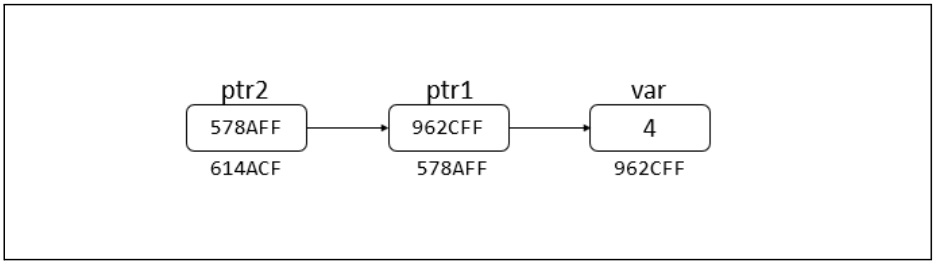
Example:
int val = 100;int* ptr1 = &val; // Stores the memory address of `val` in `ptr1`int** ptr2 = &ptr1; // Stores the memory address of `ptr1` in `ptr2`cout << "Value of val: " << **ptr2 << endl; // Outputs 100G. Working with Pointers:
Pointers and Arrays
Pointers can be used to navigate through the elements of an array.
Example:
int arr[] = {1, 2, 3, 4, 5};int* ptr = arr; // The pointer points to the first array elementfor (int i = 0; i < 5; i++) { cout << "Element " << i << ": " << *(ptr + i) << endl;}Output:
Element 0: 1Element 1: 2Element 2: 3Element 3: 4Element 4: 5Pointers and Functions
Pointers can also be used in functions to pass addresses instead of copying data, allowing for modification of the original data or more efficient handling of arrays.
Example:
// Function to modify a value via a pointervoid increment(int* ptr) { (*ptr)++;}
int main() { int value = 10; increment(&value); // Pass the address of the value cout << "Value after increment: " << value << endl;}Output:
Value after increment11Pointers and Classes
Classes can contain pointers to other objects or to themselves. Pointers can also be used to create dynamic objects using new.
Example:
class MyClass {public: int value; MyClass(int v) : value(v) {} void show() { cout << "Value: " << value << endl; }};
int main() { MyClass* objPtr = new MyClass(100); // Allocate a dynamic object objPtr->show(); // Call the function via the pointer delete objPtr; // Free the memory}Output:
Value100Types of Pointers
Constant Pointer (const pointer)
Definition: A pointer that cannot change the address it points to after it is assigned, but the data at that address can still be modified.
Usage: When you need a pointer to always point to the same address throughout the program’s execution, without changing the address.
Example:
int x = 10;int* const ptr = &x;int y = 2;ptr = &y; // Error*ptr = 4; // ValidPointer to a Constant (pointer to a constant)
Definition: A pointer that cannot modify the value stored at the address it points to, but can change the address it points to.
Usage: When you want to allow changing the pointer’s address but ensure that the value at the address cannot be modified.
Example:
int x = 10;const int* ptr = &x;*ptr = 4; // Errorint y = 2;ptr = &y; // ValidConstant Pointer to a Constant Value (Constant Pointer to a Constant Value)
Definition: A pointer that cannot change the address it points to, nor can it modify the value stored at that address.
Usage: When you want to ensure that the pointer remains fixed, always pointing to the same address, and that the value at that address cannot be modified.
Example:
int x = 10;const int* const ptr = &x;*ptr = 4; // Errorint y = 2;ptr = &y; // ErrorCommon Memory Issues
Memory issues mainly result from coding errors, especially in languages requiring manual memory management. These can affect program stability and performance, leading to crashes, incorrect results, or even security vulnerabilities. Common memory issues include:
Memory Leaks: Occurs when allocated memory is not freed, leading to excessive memory use and decreased program performance.
Example:
void func() { int* data = new int[100]; // Allocate memory for an array // Forgetting to free memory with `delete[]` // delete[] data; // Memory leak}Use-After-Free: Occurs when memory is accessed after it has been freed, leading to undefined behavior or security vulnerabilities.
Example:
int* ptr = new int;delete ptr; // Free memory*ptr = 10; // Unsafe access after freeing memoryUninitialized Pointers: Using uninitialized pointers may lead to undefined behavior, such as program crashes or incorrect data access.
Example:
int* ptr; // Uninitialized pointer*ptr = 5; // Undefined behaviorDouble Free: Attempting to free the same block of memory more than once can crash the program or lead to security exploits.
Example:
int* ptr = new int;delete ptr; // Free memorydelete ptr; // Free memory againBuffer Overflow: Occurs when accessing memory outside the bounds of an array or allocated object, potentially leading to data corruption or security breaches.
Example:
int* arr = new int[5];arr[5] = 10; // Buffer overflowConclusion
In this section, we discussed memory allocation mechanisms in C++, including static and dynamic allocation. We explained pointers, their benefits, definitions, uses, types, and common memory issues like memory leaks, use-after-free, uninitialized pointers, double-free, and buffer overflows. By understanding these mechanisms and issues, developers can write safer and more efficient C++ code.