
SimplifyC++ Article
From Native GUIs to WebAssembly: The Evolution and Future of Application Interfaces
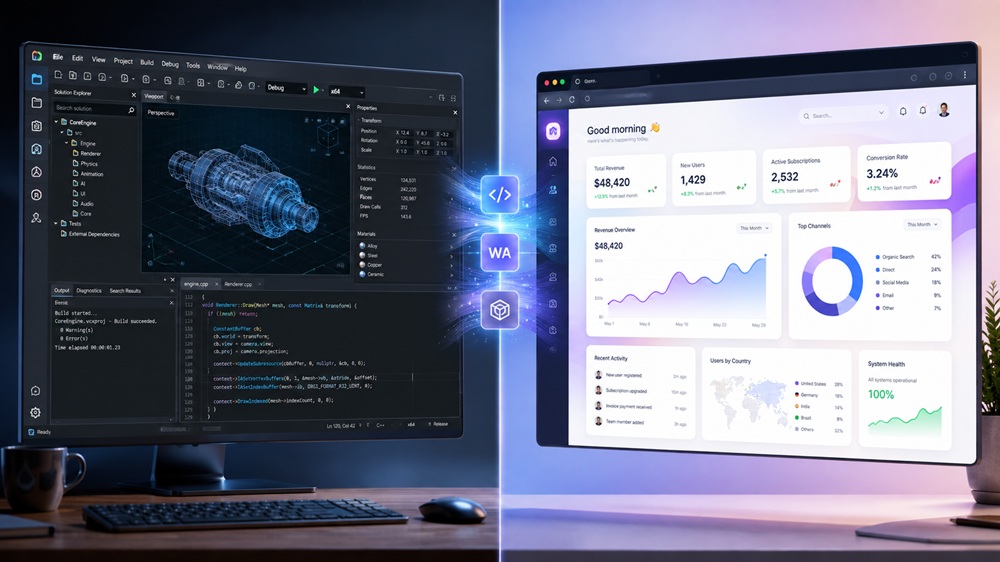
Application interfaces have evolved from traditional Native desktop GUIs to Web, mobile, cross-platform, and Hybrid architectures. Today, the question is no longer simply Native or Web? The better question is: Which technology should handle each part of the application?
Native Applications
Native applications run close to the operating system:
Application
   ↓
Native GUI
   ↓
Operating System
They remain strong because they offer:
- High performance
- Low resource usage
- Deep system integration
- Direct hardware and filesystem access
- Predictable behavior
They are especially suitable for CAD, IDEs, engineering tools, media software, games, and other demanding applications.
Their main disadvantage is that highly customized modern interfaces can require more work.
Web Applications
The Web evolved from simple HTML documents into a complete application platform through:
HTML + CSS + JavaScript
Modern CSS provides responsive layouts, animations, effects, Grid, Flexbox, SVG, and sophisticated visual design.
For creating attractive interfaces quickly, the Web is often the easiest option.
Its greatest advantage is distribution:
Open URL
   ↓
Use Application
The same application can run on Windows, Linux, macOS, tablets, and phones without traditional installation.
For CRM, dashboards, publishing, administration, collaboration, and business systems, Web applications are often the most practical choice.
However, browsers introduce additional runtime layers and restrictions, so Web applications may consume more resources and have less direct system access than Native software.
Modern Native UI
Native development has also evolved.
SwiftUI, Jetpack Compose, Qt Quick/QML, and similar technologies use declarative UI concepts:
UI = function(State)This makes modern Native interfaces easier to build and brings Native development closer to ideas popularized by Web frameworks.
Qt, for example, allows architectures such as:
QML / Qt Quick
      ↓
     C++
      ↓
Application Engine
Flutter follows another cross-platform approach, targeting mobile, desktop, and Web from a largely shared codebase.
Hybrid Applications
Hybrid architecture combines Web-style interfaces with Native capabilities.
For example:
HTML + CSS + JavaScript
          │
          ↓
       WebView
          │
          ↓
       C++ Core
This gives developers the visual flexibility of the Web while preserving Native performance and platform access.
Electron takes a Web-first approach by packaging Chromium and Node.js, while WebView-based applications can keep a Native core and use Web technology only for the UI.
Hybrid systems are increasingly attractive because they avoid forcing one technology to do everything.
Where WebAssembly Fits
WebAssembly, or Wasm, allows languages such as C, C++, and Rust to run efficiently in Web environments.
A typical architecture is:
HTML / CSS
    ↓
JavaScript
    ↓
WebAssembly
    ↓
C++ / Rust
WebAssembly does not replace HTML, CSS, or JavaScript.
- HTML provides structure.
- CSS provides design.
- JavaScript handles browser interaction.
- WebAssembly handles performance-intensive compiled code.
For example, an image editor could use HTML and CSS for its interface while running image-processing algorithms written in C++ through WebAssembly.
Combined with technologies such as WebGPU, Wasm makes increasingly demanding applications practical inside browsers.
Why WebAssembly Matters for C++
WebAssembly can make C++ more portable.
Instead of rewriting the main engine for every platform:
C++ Core
   ↓
WebAssembly
The same computational core can potentially serve Web interfaces and other environments.
This encourages a clean separation between:
User Interface
      │
Application Engine
The UI can use the technology best suited for design, while C++ or Rust handles performance-critical work.
Simple Comparison
| Requirement | Usually Best |
|---|---|
| Fast UI development | Web |
| Visual flexibility | Web / Flutter / Qt Quick |
| Maximum performance | Native |
| Lowest resource usage | Native |
| Deep OS integration | Native |
| Easy distribution | Web |
| Cross-platform reach | Web |
| Heavy professional software | Native / Hybrid |
| Cross-platform mobile | Flutter |
| Native mobile | SwiftUI / Jetpack Compose |
| Modern UI + powerful engine | Hybrid |
| High-performance code in Web | WebAssembly |
The Likely Future
The future is unlikely to be purely Native or purely Web.
A more realistic architecture is:
        Application
            │
     ┌──────┴──────┐
     │             │
    UI          Core Engine
     │             │
Web / QML      C++ / Rust
Flutter          │
     │       Native / Wasm
     └──────┬──────┘
            │
         Platform
Web will remain strong because of its design flexibility and distribution.
Native will remain essential for performance, system integration, and professional software.
WebAssembly will expand the role of compiled languages inside Web applications.
Hybrid architectures will increasingly combine them.
Conclusion
The simplest summary is:
Web is often the easiest place to build the interface. Native code is often the strongest place to build the engine. WebAssembly helps connect the two.
The future of application development is therefore not really Native versus Web.
It is:
Use the right technology for the right layer.
What did you think?
Sign in to react or comment.
Comments
0No comments yet.