SimplifyC++ Article
C++… The Language You Can Build a Language With—and Bring a Dream to Life
There is a special satisfaction in writing a program that works. But that satisfaction becomes something deeper when you use a programming language to build another language: designing its instructions, writing its compiler, creating its editor, and then watching your first program become instructions executed by the processor.
At that moment, you look at the tool that made it possible and say with sincere admiration: What a remarkable language you are, C++!
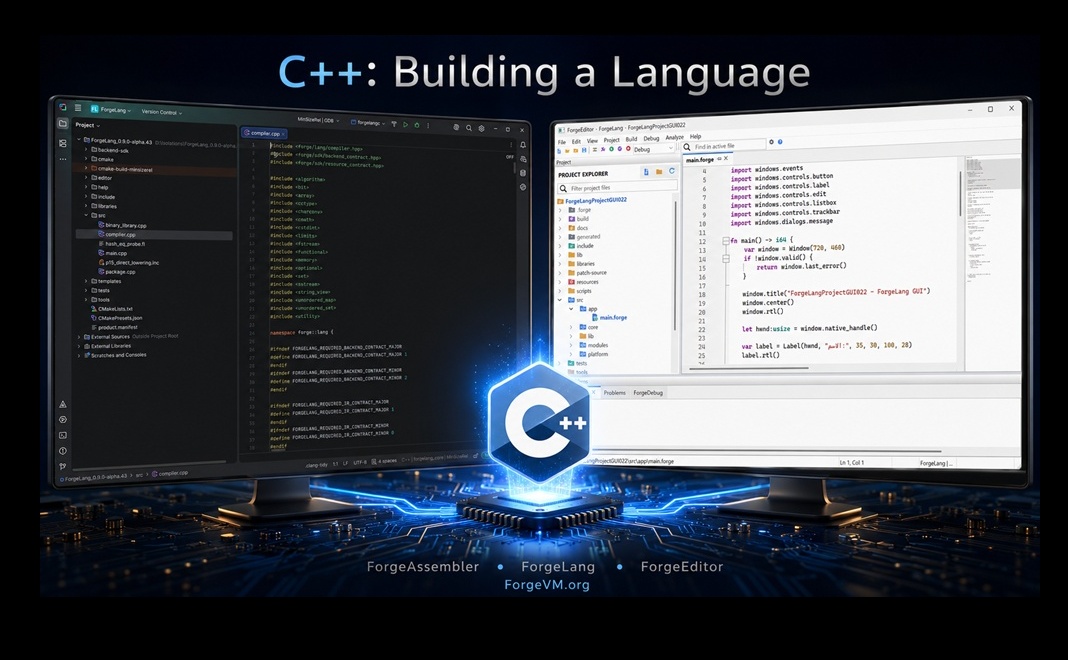
Since , I have been building the tools for my ForgeVM.org project using C++. Along this journey, I have nearly completed the alpha version of ForgeAssembler, which I plan to make available for testing soon.
Writing an assembler means working with details that leave no room for compromise: instruction encoding, registers, addresses, symbols, linking, and executable file formats. This is territory where the correctness of every byte becomes the programmer’s direct responsibility.
Here, the strength of C++ becomes unmistakable: it gives you the means to organize a large project while staying with you all the way down to the finest details of the machine.
And from the assembler… a new language began to take shape.
On this foundation, I designed a systems programming language aimed at high performance, close to the processor, operating system, and hardware, guided by two principles I deeply value:
- Zero-cost abstractions.
- You only pay for what you use.
The goal is to give programmers clarity of expression and powerful abstractions while preserving control over resources and performance. Memory management operates without a garbage collector (GC), with a design intended to provide strong memory-safety guarantees. Memory safety requires clear rules and mechanisms; simply removing a garbage collector does not establish it.
Early experiments have shown performance close to C, C++, and Rust in the tests I have conducted. These encouraging results motivate me to continue measuring and improving, working toward a release that others can test and evaluate for themselves.
And how satisfying it is that C++ is the language helping me build this entire experience!
A powerful language, supported by tools worthy of it.
Throughout this journey, CLion from JetBrains has been an excellent environment for managing the project, navigating its components, and examining its details. Together with CMake, it has provided a solid foundation for organizing builds, dependencies, and configurations as the project grows.
Meanwhile, GNU GCC has been an essential companion in turning this work into efficient native programs. The project targets Windows and Linux on x86-64 processors, using static linking for redistributable dependencies to make the tools easier to distribute and run.
Because a language also needs a comfortable environment in which to write it, I built an editor using wxWidgets, drawing on Scintilla for code editing, syntax highlighting, and formatting tailored to the new language.
The development experience gradually began to come together: writing code, building it, highlighting error locations in red, copying diagnostic messages for research and analysis, and using debugging tools to understand what happens during execution.
Each feature brings the project one step closer to becoming an environment where programmers can work comfortably and confidently.
This is where I understand why I love C++.
I love the breadth of possibilities it gives a programmer. I can build a graphical interface, move into parsing a language’s grammar, then work on memory management and machine-code generation—all within one language and a mature ecosystem of tools.
I also love how experience with C++ compounds. The more deeply I understand it, the more precise the tools I discover for expressing designs, controlling costs, and organizing complexity.
Building a language, an assembler, and an editor remains a substantial undertaking, requiring patience, testing, and continuous review. But C++ makes that ambition something I can turn into a real project: source files that build, tools that work, and programs that execute what I imagined.
My appreciation comes from an experience I live every day: using C++ to write the tools with which I will create tomorrow.
What a beautiful language you are, C++… As I build a new language with you, every stage gives me another reason to love you.
What did you think?
Sign in to react or comment.
Comments
0No comments yet.