
SimplifyC++ Article
The Battle for Hardware Control: Does C Outperform C++ and Rust in Low-Level Programming?
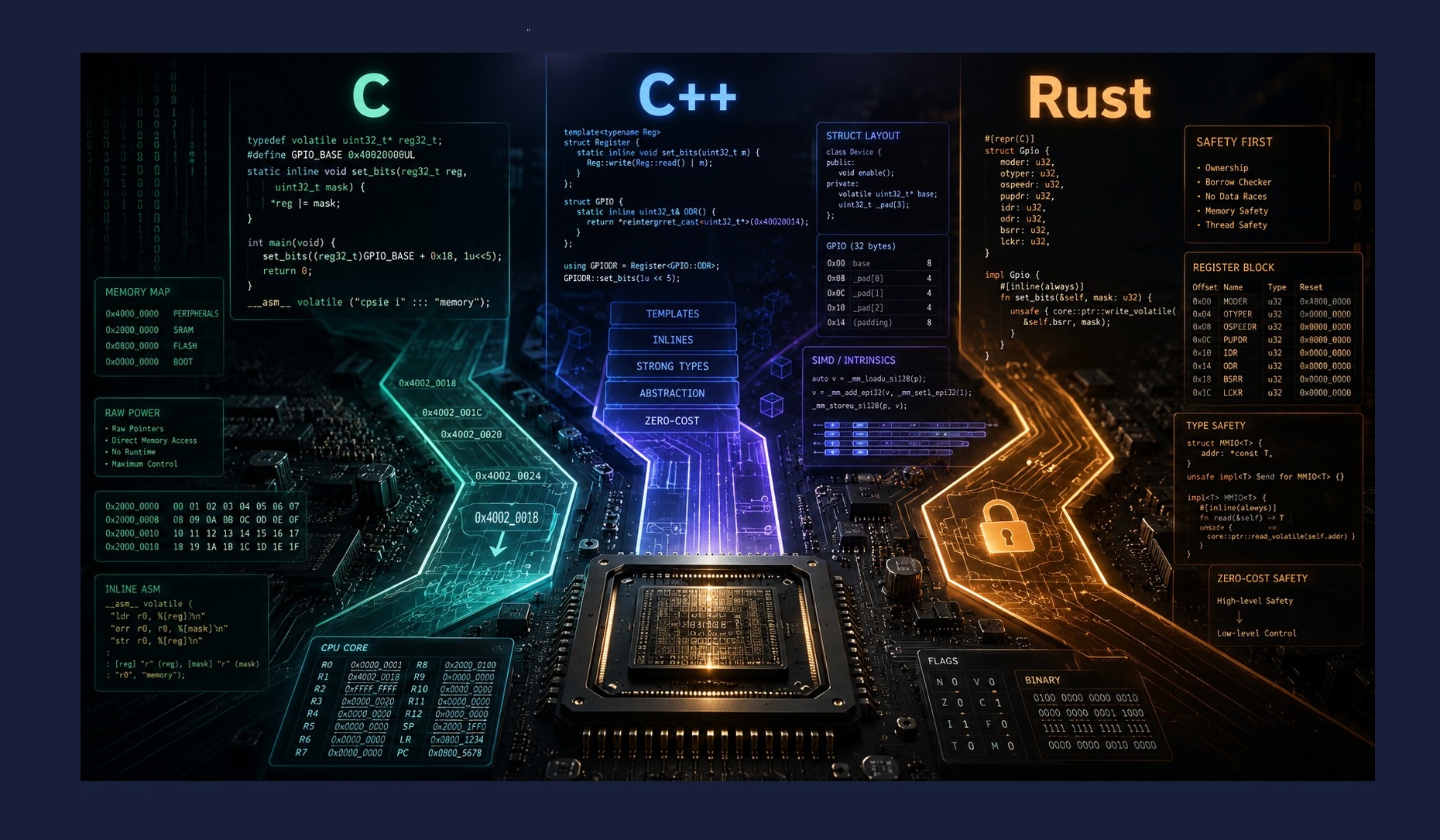
Deep in the world of programming, where operating systems are woven, processor cores are managed, and microcontrollers are programmed, low-level languages stand as indispensable tools. Among these, C holds a legendary status as the mother of systems languages, while C++ offers a powerful extension, and Rust brings a modern revolution with its strict safety promises. But when it comes to precise hardware control and direct manipulation of memory and registers, does C still truly excel, or have the other two languages caught up and become true rivals? This article dives deep into these three languages to uncover their real capabilities in the arena of low-level programming.
What Do We Mean by “Low-Level Constructs”?
Before diving into the comparison, we must define the term precisely. Low-level programming does not simply mean writing code that runs fast; it means the ability to:
- Directly access physical memory addresses and manipulate raw pointers.
- Precisely control the layout of data structures at the byte level, including removing or adjusting padding.
- Embed assembly instructions within source code (inline assembly) to perform operations that cannot be expressed in a high-level language.
- Use intrinsics—built-in functions that represent specific processor instructions, such as SIMD (SSE, AVX) or cryptographic instructions.
- Manage memory manually without any intermediary layer enforcing checks or garbage collection.
These capabilities allow the programmer to control every pulse of the hardware, and this is the arena where our three languages compete.
C: Transparent Simplicity and Absolute Control
C was designed at Bell Labs in the early 1970s to write the Unix operating system, and it has remained the first choice for everything systems-related ever since. The secret of its power lies in its philosophy: no forced abstractions. Everything in C is close to the hardware, and the compiler does not interfere except when asked.
In C, you can declare a pointer to any memory address and read from or write to it directly. You can use #pragma pack or __attribute__((packed)) to control structure layout so that it exactly matches the layout of hardware registers. You can write inline assembly easily using the well-known asm syntax in GCC and Clang. Intrinsic libraries such as <immintrin.h> are also available for using modern SIMD instructions.
C's greatest advantage is transparency. What you write is almost exactly what the processor executes, without surprises or hidden transformations. This simplicity makes it easy to predict code behavior at the hardware level, which is critical in real-time systems or when writing device drivers.
But this absolute freedom comes at a price: there are no safety guarantees. Out-of-bounds array access, using a freed pointer, or writing outside a buffer are all common errors that lead to security vulnerabilities and unexpected crashes. The programmer is solely responsible for every byte.
C++: The Power of C with Optional Abstraction Layers
C++ was born as an extension of C and maintains near-complete compatibility with it. This means all of C's low-level capabilities are available in C++, along with powerful additions such as classes, templates, and exceptions. Importantly, these additions do not impose themselves; you can write C++ code that looks almost like C if you want full control.
In C++, you can use raw pointers freely, and control object layout via #pragma pack or alignas. Inline assembly is available with the same syntax as C, and intrinsics are accessible through the same headers. Moreover, C++ provides additional tools like reinterpret_cast, which can be clearer in expressing intent than C's implicit casts.
The only challenge in C++ is that some high-level features can introduce invisible complexity if you are not careful. For example, virtual functions add a hidden pointer to a vtable, and exceptions may generate extra code for stack unwinding. But all of this is optional; you can disable or avoid them entirely when writing low-level code.
Thus, C++ is not less capable than C in this domain; rather, it offers the same power with the ability to build safe abstractions on top when needed, without sacrificing performance.
Rust: Safety First, but Without Compromising Power
Rust is a modern language designed by Mozilla to eliminate entire classes of programming errors that plague C and C++, such as memory errors and data races. To achieve this, Rust enforces a strict ownership and borrowing model in safe code. At the same time, it fully recognizes that low-level programming sometimes requires breaking these rules, so it provides the unsafe block where everything is permitted.
Inside an unsafe block in Rust, you can:
- Use raw pointers (
*const T,*mut T) and perform pointer arithmetic. - Call unsafe functions (such as system calls or C functions).
- Control structure layout using
#[repr(C)]or#[repr(packed)]. - Use inline assembly via the
asm!macro. - Access intrinsics through the
core::archandstd::archmodules.
The beauty of Rust is that all unsafe code is isolated and clearly marked, making code review easier and safer. The compiler also enforces strict rules even within unsafe in some cases, such as preventing out-of-bounds indexing unless you explicitly use get_unchecked.
So, in terms of capability, Rust is not inferior to C or C++ in accessing hardware. The difference is that Rust enforces discipline: you must be deliberate in using unsafe features and take responsibility for documenting why they are considered safe in your context. This may seem like an extra burden, but it actually reduces the catastrophic errors that result from unintentional negligence.
Does C Really Excel? A Critical Analysis
After reviewing the capabilities of each language, it becomes clear that the answer to “Does C excel?” is no—not from a technical standpoint. All three languages provide the same level of access to hardware and the same ability to control memory, registers, and processor instructions.
The reason for C's continued dominance in some fields is not technical superiority, but practical and historical factors:
- Extreme simplicity: C is a small, easy-to-understand language that does not require learning complex models like templates or ownership systems. This makes it ideal for resource-constrained embedded systems where the compiler itself must be simple.
- Pervasiveness and compatibility: Operating system kernels, most device drivers, and core system libraries are written in C. Any language that wants to interact with these components must be able to call C functions, making C the natural choice.
- Tooling and ecosystem: C compilers and supporting tools are extremely mature and available for almost every platform, from the smallest microcontrollers to the largest servers.
- Full control without “noise”: In C, there is no protection layer, no need to mark code as
unsafe, and no borrowing rules to deal with. This can make you more productive in certain contexts where you are in full command.
However, these advantages do not imply superiority in capabilities; they are advantages in suitability. If you want to write an operating system kernel from scratch, C will be the most straightforward choice. But if you are building a large project that requires high performance and memory safety with the ability to fine-tune when needed, Rust offers an unmatched combination. And if you want to reuse massive C codebases while building high-level interfaces, C++ is the optimal choice.
Conclusion: Equal in Capability, Different in Philosophy
Ultimately, it can be said that C, C++, and Rust are almost equal in their ability to perform low-level programming. The fundamental differences are not in the “quantity” of low-level constructs, but in the philosophy each language adopts:
- C: Absolute freedom with simplicity and transparency, but without a safety net.
- C++: The same freedom as C with the ability to build powerful abstractions, but it requires self-discipline to avoid unwanted complexity.
- Rust: The same control capability, but with a strict system that enforces safety and makes unsafe code visible and isolated.
Therefore, when choosing a language for your next systems or hardware project, do not ask “Which language is more powerful?” but rather: “Which philosophy best suits my team and my project's requirements?” True power lies not in the language itself, but in the programmer's ability to use its tools wisely.
What did you think?
Sign in to react or comment.
Comments
0No comments yet.