
SimplifyC++ Article
Philosophy, Scientific Research, and Invention… How Do We Change the World We Seek to Understand?
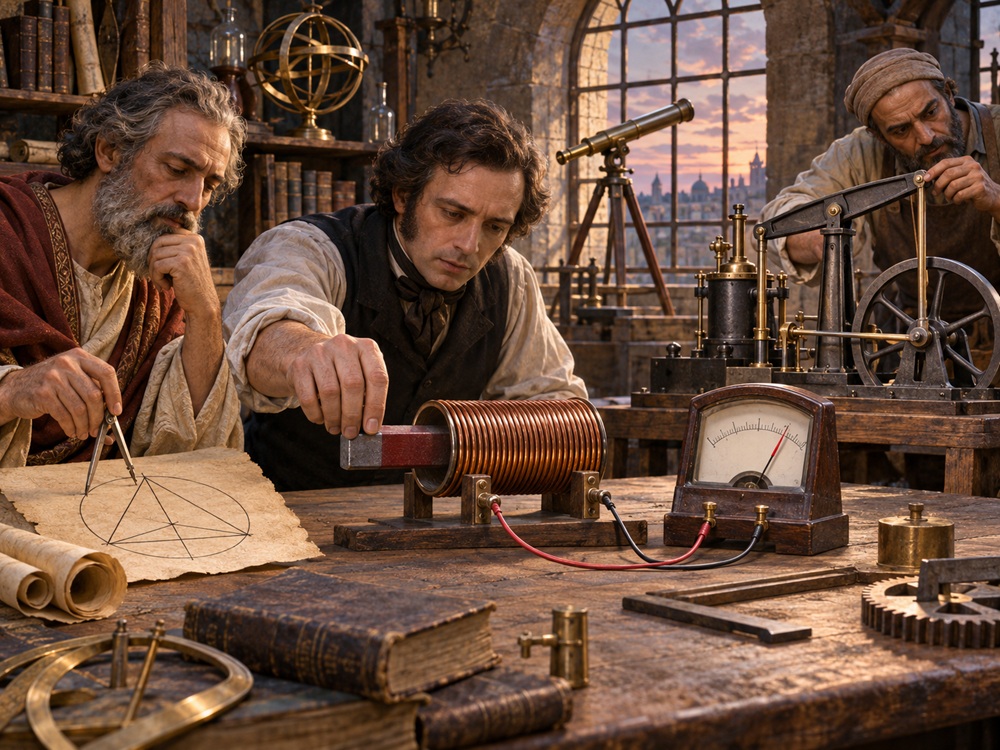
In 1831, Michael Faraday moved a magnet inside a coil of wire. The needle on his measuring instrument deflected, indicating an electric current. The principle revealed by that experiment became the basis for how electric generators work. How many inventions began with a question like this? And how many scientific questions occurred to people only after they began using a new machine? Royal Institution
These two paths reveal the relationship among philosophy, scientific research, and invention. We examine our ideas so we can ask better questions. We investigate the world to see which answers stand up to the evidence. And we design tools so we can do things we could not do before. The process may begin with an idea, a puzzling observation, or a problem a craftsperson encounters at work.
How Do Philosophers, Researchers, and Inventors Think?
A philosopher examines the question and the reasoning that leads to an answer. When we say that one event caused another, the philosopher asks what we mean by a cause and what justifies moving from the observation that one event followed another to the conclusion that one caused the other. When technology gives us a new capability, the philosopher asks what purpose it should serve and what rights the people affected by it have. Philosophical thinking can be complex because the problem itself is intricate. Its quality shows in the ability to untangle the problem and state the argument clearly. In the twentieth century, Karl Popper offered an example of this kind of thinking when he proposed that a hallmark of a scientific theory is that it can be tested in a way that might show it to be wrong. Stanford Encyclopedia of Philosophy, Karl Popper
A scientific researcher asks what evidence would favor one explanation over another. A researcher might change a single factor in a controlled experiment to see what effect it has. When the phenomenon cannot be manipulated, as in astronomy, the researcher might compare observations made over time. The work also involves building models and specifying where the findings apply. Research may begin with a desire to understand a phenomenon, and a practical use for that understanding may emerge years later. Stanford Encyclopedia of Philosophy, Scientific Method
An inventor asks how to make a possible solution work in practice. An inventor may know the principle behind a machine and still spend most of the time choosing materials, adjusting parts, and testing the prototype until people can rely on it. An idea may grow out of practical experience or from noticing a recurring fault. A successful prototype shows that the solution works under the conditions tested. Studying how it works answers a broader question and can inform the design of other devices.
From Natural Philosophy to Measurement and Machine Building
In the fourth century BCE, Aristotle asked what makes an explanation of a phenomenon adequate and distinguished different kinds of causes in his natural philosophy. In the third century BCE, Eratosthenes took a different approach to a question about the size of Earth. He compared the angles of the Sun's rays relative to the vertical in Alexandria and Aswan, combined this information with an estimate of the distance between the cities, and used geometry to calculate Earth's circumference. His method shows how an everyday phenomenon such as a shadow can help us measure something beyond the reach of direct measurement. Stanford Encyclopedia of Philosophy, Aristotle's Natural Philosophy · OpenStax, Ancient Astronomy
In the Islamic world, Hasan ibn al-Haytham investigated how vision works in the eleventh century. In his Book of Optics, he combined geometric analysis with experiments on the behavior of light. His account of vision rested on the idea that light from visible objects enters the eye. About two centuries later, Badi' al-Zaman al-Jazari documented designs for water clocks and water-raising machines in his Book of Knowledge of Ingenious Mechanical Devices. His surviving drawings show how an engineer could pass on the knowledge of his craft so that later generations could study the arrangement of the parts and how they moved. UNESCO, Ibn al-Haytham's Scientific Method · UNESCO, Ibn al-Haytham's Studies of Light and Vision · The Metropolitan Museum of Art, Al-Jazari's Water Clock · The Metropolitan Museum of Art, Al-Jazari's Water-Raising Machine
From the Telescope to the Steam Engine and the Computer
In the early seventeenth century, Galileo built a telescope after hearing about an optical instrument that had appeared in Europe. He then improved its magnification. In 1610, he used it to observe objects that changed position near Jupiter from one night to the next and concluded that they were four moons orbiting the planet. An optical instrument had made it possible to test an idea about the structure of the heavens. The fact that these moons orbited Jupiter showed that celestial bodies could orbit centers other than Earth. NASA, Observing Jupiter's Moons · Library of Congress, Galileo and the Telescope
Thomas Newcomen developed his steam engine to pump water out of mines. The first engine of its kind went into operation in 1712. James Watt later developed a separate condenser that reduced heat loss. In 1824, Sadi Carnot asked what limits govern the efficiency of any heat engine. Engineers had learned how to build engines that did useful work, and their work became the starting point for a broader study of the relationship between heat and work. The British Journal for the History of Science · American Physical Society, Carnot's Study · National Museums Scotland, The Newcomen Engine
In computing, one line of inquiry began with mathematical logic. In 1936, Alan Turing devised a theoretical model to study what can be computed by following a set of rules. Many mathematicians and engineers contributed to the developments that followed. In 1948, the University of Manchester's Baby computer ran its first program, which was stored in the machine's memory. The distance between Turing's question and the Manchester team's achievement was bridged by mathematical reasoning, circuit design, and the construction of computer memory. Stanford Encyclopedia of Philosophy, The Modern History of Computing · The University of Manchester, The Baby Computer
Who Makes This Progress Possible?
One person can play several of these roles, as Ibn al-Haytham did when he developed explanations and designed experiments. The work can also be shared across professions and generations, as in the history of the steam engine. A philosopher reexamines what counts as evidence. A researcher patiently revises a hypothesis. An engineer or craftsperson notices a detail while working that someone looking at the drawing alone might miss. Each contribution becomes more valuable when it is described precisely enough for others to understand, scrutinize, and build on it.
The relationship continues after a tool reaches our hands. A smartphone can determine its location. A researcher can measure the margin of error, and an engineer can improve accuracy and reduce battery consumption. A question then arises for anyone who carries a phone. Who has the right to know the owner's location, and for what purpose? Answering that question requires understanding what the technology can do and thinking about what we want it to do and whose rights it should respect. The range of questions we can ask expands as the range of things we can make grows.
What did you think?
Sign in to react or comment.
Comments
0No comments yet.